

Maths
Fractions, percentages, area and perimeter, angles, time, place value, ratio and the rest, each with a worked tip.
For Years 4, 5 and 6 · GL, consortium and ISEB
Bite-sized maths, English and reasoning, built for 9 to 11 year olds. Ten minutes before bed does more than an hour of arguing over a workbook. Free to download, and free to start.
 See it working first
A sample of all four subjects in your browser. No account, nothing to install.
Try it free
See it working first
A sample of all four subjects in your browser. No account, nothing to install.
Try it free
Then, one payment unlocks the full course material on every device. No subscription.
Free to download. One optional £19.99 unlock inside, never a subscription.

No sign-up, no email
Four real questions from the app, one from each paper. This is the level, the wording and the feedback your child gets.
Maths
D. 80°. The three angles of any triangle add up to 180°. 35 + 65 = 100, and 180 − 100 = 80.
The three angles of any triangle add up to 180°. 35 + 65 = 100, and 180 − 100 = 80.
From the app’s own question bank · quiz.5.q10
English
C. Slander. To vilify someone is to speak about them abusively, which is to slander them. The other three all mean the opposite, which is the trap.
To vilify someone is to speak about them abusively, which is to slander them. The other three all mean the opposite, which is the trap.
From the app’s own question bank · quiz.33.q6
Verbal Reasoning
B. WLT. Each letter is swapped for its mirror in the alphabet: A↔Z, B↔Y, C↔X. So D→W, O→L, G→T.
Each letter is swapped for its mirror in the alphabet: A↔Z, B↔Y, C↔X. So D→W, O→L, G→T.
From the app’s own question bank · quiz.18.q5
Non-Verbal Reasoning
C. C. The arrow turns 90° clockwise each step, and the dot stays in the same corner of the square while it does.
The arrow turns 90° clockwise each step, and the dot stays in the same corner of the square while it does.
From the app’s own question bank · figure drawn for this page
Try more before you download
A sample of all four subjects in your browser. No account, nothing to install.
Try it free
Then, one payment unlocks the full course material on every device. No subscription.
The actual problem
Nobody buys another workbook because they ran out of questions. They buy because the evening turns into a negotiation, and the workbook stays shut.
So the app is built around the one thing a workbook cannot do: making a child want to come back tomorrow. Every question studied lays a block. Blocks stack into a tower. Practise on consecutive days and a streak builds, and there are four characters to find (one per paper) who only grow when that paper does.
It is deliberately behavioural rather than decorative. A child who only ever does maths looks at three grey silhouettes, and goes and does some English.
2 of 4 friends found
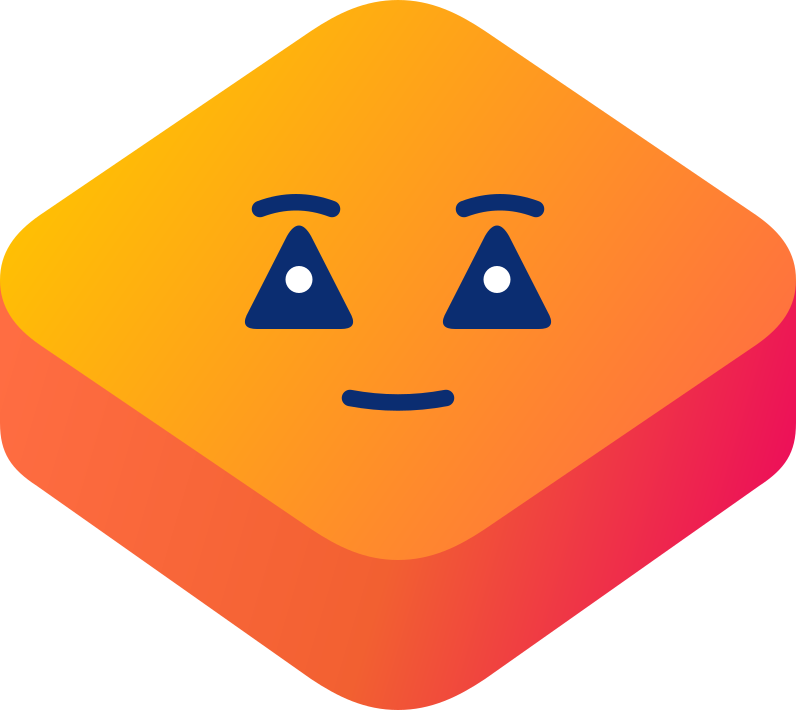
Each friend gains a block as its paper is mastered, at 5%, 20%, 45% and the whole thing. Blockie is the sum of the other four.
What’s inside
Four complete courses, taught topic by topic, plus 36 mixed quiz papers and 242 vocabulary cards.
Fractions, percentages, area and perimeter, angles, time, place value, ratio and the rest, each with a worked tip.
Grammar, punctuation, word classes, figurative language and the comprehension vocabulary examiners keep returning to.
Letter codes, missing letters, odd one out and word logic, in the shapes the GL papers actually use.
Shape sequences, rotations, reflections and the odd figure out, every one with its own drawing rather than a description of one.
Every word with its meaning, an example sentence and its synonyms. Shuffled into a recall deck, so your child has to remember it before it flips.
Ten questions, mixed across all four papers, scored on accuracy. The closest thing in the app to the real exam.
Every topic comes in easier and harder. Start where your child is, not where the book assumes they are.
The question behind the question
There is no national mark scheme to check yourself against, so most parents are working from a feeling. That is what makes the whole thing so tiring.
The app tracks every question answered, by topic. You can see which parts of maths are solid, which have never been touched, and what your child scored the last three times they sat a paper. Not a percentage of a syllabus nobody publishes, just what has actually been done, and what has not.
It is in the app rather than emailed to you, because a child who knows a report is going to a parent stops answering honestly.
Topics mastered
Maths
7/12
English
2/5
Verbal
1/4
Non-verbal
0/4
Three weeks of maths, and English barely touched. That is the conversation the screen is there to start.
The calendar nobody hands you
Results usually arrive in mid-October, before the 31 October application deadline, and offers land on 1 March 2027. Whatever happens, the maths and English do not stop being useful.
You register with the local authority or directly with the school. Kent and Buckinghamshire close earliest, often before the end of term.
Most grammar schools test in the first weeks of Year 6. Independent schools run ISEB pre-tests from November and their own papers in January.
Deliberately before the application deadline, so you can decide which schools to put down knowing how it went.
The national closing date for the secondary school application form. Miss it and you are treated as a late applicant.
Every family finds out on the same day, for entry that September.
Dates vary by county and by school. Always check the admissions page of the schools you are applying to. Our 11 Plus guide covers the regional differences.
What it costs
Most people can’t. A single hour with an 11 Plus tutor costs more than everything here, for good.
Full access
£19.99
One payment of £19.99. Not a subscription.
Try it first. The app is free, and you only unlock when you have decided it suits your child. Payment happens through the store the app came from, so it is covered by that store’s refund process and your existing family payment settings: the App Store on iPhone and iPad, Google Play on Android.
Look at it first, for nothing
A sample of all four subjects in your browser, so you can judge the level before you spend anything.
Try it free
Then, one payment unlocks the full course material on every device. No subscription.
Where the questions come from
Every question is authored against the topics the 11 Plus actually tests, by a parent who took his own two children through the exam.
Accuracy is part of how a question gets in, not a review afterwards. Anything whose answer does not match its own working is refused rather than flagged, and the whole bank is checked again every time the content changes.
No advertising, no third-party trackers, and nothing sold on. Progress is stored on the device and in your own iCloud or Google Drive. Create an account and it follows your child to a laptop too.
Years 4, 5 and 6, roughly 8 to 11. Most children start in Year 5, a year before the exam. Every topic has an easier and a harder level, so a Year 4 starting early and a Year 6 revising are both catered for.
The content is built to strengthen the underlying skills rather than to drill one exam format, so it works for GL Assessment (used by most grammar schools), the ISEB Common Pre-Test for independent schools, and the bespoke consortium papers such as CSSE in Essex, Kent PESE and SET in Sutton.
CEM withdrew its paper 11 Plus tests after 2022 and most schools moved to GL, so anything still promising “CEM-style” practice is out of date.
No. That is rather the point. Questions are answered by tapping, every answer explains itself, and nothing needs marking. You can look at their progress whenever you want, but the session itself is theirs.
One payment of £19.99. Not a subscription. You download the app free, try it, and unlock the full question bank from inside the app if it suits your child. There is nothing recurring to cancel.
Yes. The questions live on the device, so a car journey, a train or a plane all work. Progress syncs when you are back online.
Yes, on Google Play, and it is the same app as on iPhone and iPad: the same courses, the same practice papers, the same optional unlock. Progress follows the account, so a child can move between a phone, a tablet and a browser.
Download it, hand your child the phone, and see whether they finish the first ten questions without being asked. That is the only test that matters.
Or see it in your browser first
A sample of all four subjects. No account, nothing to install.
Try it free
Then, one payment unlocks the full course material on every device. No subscription.
iPhone and iPad, iOS 14 and later. Android coming after the iOS release.
Free guides on the exam, the timetable and the schools.
GL, ISEB, CAT4 and the regional consortium papers, and what each one asks for.
Individual grammar and independent schools, their tests and their catchments.
Sample questions, worked methods and how to revise without burning out.
Exam nerves, realistic expectations and what to do when it is not going well.