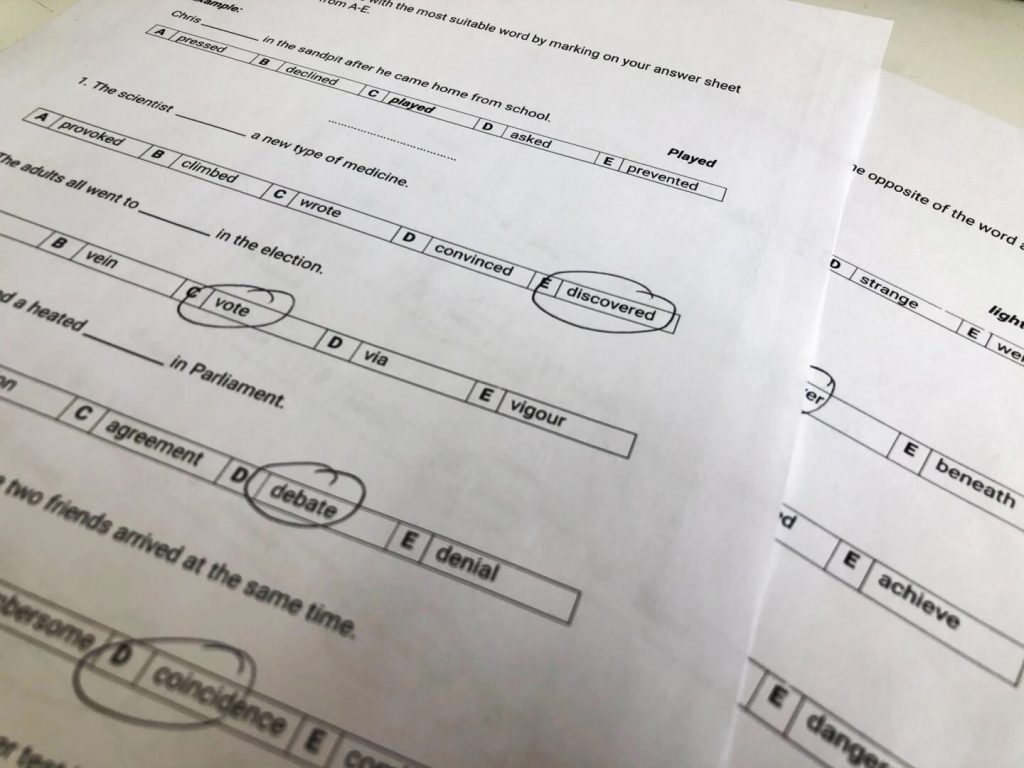


Verbal reasoning is one of the most misunderstood parts of the 11 plus exam. It looks like English, but it isn’t really testing reading comprehension in the traditional sense. Instead, it focuses on how well a child can recognise patterns in language, manipulate words, and think logically under time pressure.
Many students struggle with verbal reasoning, not because they lack ability, but because they don’t understand how the questions are structured. Once you break down the patterns behind these questions, the subject becomes far more manageable.
This guide covers everything you need to know about 11 plus verbal reasoning questions, including types, worked examples, strategies, and realistic practice.

What Are 11 Plus Verbal Reasoning Questions?
Verbal reasoning questions test how well a student can process and analyse written information quickly. Unlike standard English questions, they aren’t focused on comprehension or creative writing. Instead, they measure logical thinking using words, letters, and patterns.
A typical verbal reasoning paper will include a mix of question types that require students to identify relationships between words, decode letter sequences, or solve word-based puzzles. These questions are designed to assess problem-solving ability rather than memorised knowledge.
One of the reasons verbal reasoning feels difficult is that it introduces unfamiliar formats. Students may encounter question styles they haven’t seen before. This was particularly common in CEM exams, which were known for less predictable question formats before CEM withdrew from the paper-based 11 Plus market in 2023. Unfamiliar formats can create hesitation, slowing students down and leading to mistakes.
Understanding the underlying structure of these questions is what makes the biggest difference. Once students recognise patterns, they stop guessing and start solving.
GL vs CEM Verbal Reasoning Explained
GL and CEM historically approached verbal reasoning differently. CEM withdrew from the paper-based 11 Plus market in 2023, so this comparison is now primarily useful for understanding older CEM materials.
GL exams tend to use more predictable question types. Students can prepare by practising specific formats repeatedly.
CEM exams were less predictable and often combined question types or introduced unfamiliar variations. This placed greater emphasis on adaptability rather than memorisation.
Schools that previously used CEM moved to GL Assessment or introduced bespoke entrance tests. Students should therefore check the current format used by their target school and prepare accordingly. Older CEM-style materials can still be useful for developing flexibility and general verbal reasoning skills.
Types of 11 Plus Verbal Reasoning Questions

Verbal reasoning isn’t a single skill. It’s a collection of different question types, each testing a slightly different ability.
Synonyms and Antonyms
These questions test vocabulary depth. Students are asked to find words with similar or opposite meanings. The difficulty comes from subtle differences in meaning rather than obvious matches. A strong vocabulary is essential here. Without it, students rely on guesswork, which reduces accuracy.
Letter Sequences
Letter sequence questions require students to identify patterns in a series of letters. These patterns might involve skipping letters, reversing sequences, or applying positional rules. The challenge isn’t just spotting the pattern. It’s doing so quickly enough to stay within time limits.
Codes and Ciphers
These questions involve translating words into coded forms based on a rule. Students must first identify how the code works, then apply it to new words. This type heavily tests logical reasoning and attention to detail.
Analogies
Analogies require students to identify relationships between word pairs. For example, “cat is to kitten as dog is to puppy.” The difficulty lies in recognising the relationship itself, not just the words.
Hidden Words
Students must find a word hidden within a sequence of letters. This tests scanning ability and pattern recognition.
Odd One Out
These questions ask students to identify which word does not belong in a group. The reasoning could be based on meaning, spelling, or category.
Verbal Reasoning Examples with Step-by-Step Answers
Understanding examples is where most students improve rapidly. Seeing how a question is solved builds pattern recognition.
Example 1: Synonym
Word: “Rapid”
Options: Slow, Fast, Heavy, Weak
The correct answer is “Fast.”
The key is recognising that “rapid” means quick. Students who don’t know the word must rely on elimination.
Example 2: Letter Sequence
Sequence: A, C, E, G, ?
The pattern skips one letter each time. The answer is I.
Example 3: Code
If CAT = DBU, what is DOG?
Each letter shifts forward by one.
D → E, O → P, G → H
Answer: EPH
Example 4: Antonym
Word: “Expand”
Options: Increase, Grow, Shrink, Extend
The correct answer is Shrink.
“Expand” means to make something larger. The opposite is to make it smaller. The other options all relate to increasing size, so they can be eliminated quickly.
Example 5: Letter Sequence (Skipping Pattern)
Sequence: B, E, H, K, ?
Each letter increases by 3 positions:
B → E (+3), E → H (+3), H → K (+3)
K + 3 = N
Example 6: Number Code
If DOG = 4157, what is GOD?
Reverse the order:
G = 7, O = 5, D = 4
Answer: 754
This tests whether you recognise that position matters, not just the letters.
Example 7: Hidden Word
Find the hidden word in:
X T R E A S U R E P L
Look for continuous letters:
T R E A S U R E
Answer: TREASURE
Example 8: Odd One Out
Apple, Banana, Carrot, Orange
Carrot is the only vegetable. The others are fruits.
Answer: Carrot
Example 9: Analogy
Bird is to Fly as Fish is to ?
Bird → Fly (movement method)
Fish → Swim
Answer: Swim
Example 10: Alphabet Position
What letter is 3 letters after M?
M → N (1), O (2), P (3)
Answer: P
Example 11: Reverse Sequence
Z, X, V, T, ?
Pattern: -2 each time
Z → X → V → T
T – 2 = R
Example 12: Code Shift Backwards
If BOOK = ANNJ, what is COOL?
Each letter shifts back by 1:
C → B, O → N, O → N, L → K
Answer: BNNK
Example 13: Double Step Pattern
A, D, H, M, ?
Pattern increases:
+3, +4, +5
Next = +6
M + 6 = S
Example 14: Word Relationship
Puppy is to Dog as Kitten is to ?
Young → Adult
Kitten → Cat
Answer: Cat
Example 15: Missing Letters
C _ T
Options: A, O, U
Possible words: CAT, COT, CUT
Most common valid word expected:
Answer: A (CAT)
Example 16: Compound Word
Which word can follow “Sun” to form a compound word?
Options: Light, Day, Rise
All work, but the most standard compound is:
Answer: Light (Sunlight)
Example 17: Letter Pair Pattern
AB, DE, GH, JK, ?
Each pair jumps 3 letters forward:
AB → DE → GH → JK
Next: MN
Example 18: Anagram
Unscramble: L I S T E N
Rearranged: LISTEN → SILENT
Answer: SILENT
Example 19: Position Swap Code
If TOP = POT, what is RAT?
Pattern: reverse letters
RAT → TAR
Answer: TAR
Example 20: Vowel Pattern
A, E, I, O, ?
Vowels sequence
Answer: U
Example 21: Word Category
Chair, Table, Sofa, Apple
Three are furniture
Answer: Apple
Example 22: Alphabet Difference
What letter is 2 before K?
K → J (1), I (2)
Answer: I
Example 23: Mixed Pattern
2, 4, 8, 16, ?
Multiply by 2
16 × 2 = 32
Example 24: Code with Position Shift
If PEN = QFO, what is MAP?
Each letter shifts +1:
M → N, A → B, P → Q
Answer: NBQ
Example 25: Word Pair Logic
Knife is to Cut as Pen is to ?
Tool → Function
Pen → Write
Answer: Write
Verbal Reasoning Strategies That Actually Work

Recognising Patterns Quickly
Every verbal reasoning question follows a pattern, even if it doesn’t look obvious at first. The difference between slow and fast students usually comes down to how quickly they can identify what type of pattern they’re dealing with.
In letter sequences, the pattern might involve consistent jumps, alternating steps, or grouping letters into pairs. In codes, it could be a shift forward in the alphabet, a reversal, or a position swap. The key is not to stare at the question, hoping the answer appears, but to actively test possible patterns in a structured way.
With enough exposure, these patterns stop feeling new. Students begin to recognise them almost instantly, which reduces hesitation and improves both speed and accuracy under timed conditions.
Building Vocabulary Effectively
Vocabulary improvement isn’t about memorising long lists of disconnected words. That approach rarely translates well into exam performance. What matters is understanding how words relate to each other and how they’re used in context.
Students benefit more from learning synonyms in groups, exploring antonyms alongside them, and paying attention to prefixes and suffixes. For example, recognising that “submarine,” “submerge,” and “subway” all relate to something below helps decode unfamiliar words during the exam.
Regular reading also plays a role. Exposure to different sentence structures and word usage builds familiarity over time, which makes it easier to process vocabulary-based questions quickly and confidently.
Managing Time Under Pressure
Timing is often the biggest challenge in verbal reasoning papers. Many students can solve questions correctly during practice, but struggle to maintain the same accuracy when the clock is running.
The main issue is spending too long on difficult questions. When a student gets stuck, they tend to keep pushing for the answer instead of moving on. This reduces the time available for easier questions later in the paper.
A more effective approach is to set a mental limit for each question. If the pattern isn’t clear within that timeframe, it’s better to skip and return later. This keeps the overall pace steady and ensures that accessible marks aren’t lost due to poor time management.
Timed practice is essential here. It trains students to make quicker decisions without sacrificing accuracy.
Using Elimination Techniques
Elimination is one of the most practical strategies in verbal reasoning, especially when the correct answer isn’t immediately obvious. Instead of trying to find the right answer straight away, students can narrow down the options by removing clearly incorrect choices.
In synonym questions, this might involve ruling out words with the wrong tone or meaning. In sequences, it could mean identifying which options don’t follow the pattern. Even eliminating one or two incorrect answers significantly increases the chances of selecting the correct one.
This approach also reduces pressure. Instead of feeling stuck, students have a clear next step, which keeps them moving forward and maintains momentum throughout the paper.
How to Improve Verbal Reasoning Quickly
Improvement in verbal reasoning comes from targeted practice, not repetition alone.
Students should focus on weak areas rather than repeating what they already understand. If letter sequences are difficult, dedicating extra time to that question type produces faster progress.
Combining practice with review is critical. Simply answering questions isn’t enough. Understanding mistakes and correcting them is what leads to improvement.
11 Plus Verbal Reasoning Practice Questions
Practice is where improvement becomes measurable. Without consistent exposure to question types, progress stalls.
Students should use structured practice papers to simulate exam conditions. Timed practice is especially important because verbal reasoning is as much about speed as accuracy.
Working through a variety of questions builds familiarity. Over time, patterns become easier to recognise, and response times improve naturally.
Common Mistakes in 11 Plus Verbal Reasoning
Most mistakes in verbal reasoning don’t come from a lack of ability. They come from how students approach questions under pressure.
Relying on Guesswork Instead of Logic
When a question looks unfamiliar, many students guess too quickly. The problem isn’t guessing itself; it’s skipping the thinking process.
Every verbal reasoning question follows a pattern. In sequences, you check letter jumps. In codes, you look for shifts or reversals. In analogies, you identify relationships. Students who apply a consistent method, even when unsure, perform far more reliably than those who rely on instinct.
Spending Too Long on Difficult Questions
It’s easy to get stuck on one question and lose track of time. The longer a student stays on it, the harder it becomes to move on.
This creates a bigger issue. Easier questions later in the paper are rushed or missed entirely. Strong performance comes from securing as many accessible marks as possible, not solving every difficult problem.
Learning when to skip and return later is a key skill that improves overall scores.
Ignoring Vocabulary Development
Vocabulary affects far more than just synonym questions. It plays a role in analogies, sentence completion, and even understanding instructions.
Students with weak vocabulary often recognise patterns but still choose the wrong answer because they don’t fully understand the words involved. Building vocabulary through consistent exposure and understanding word relationships makes a noticeable difference across the entire paper.
Failing to Recognise Question Types
Many students jump straight into solving without identifying what type of question they’re dealing with. This slows them down and leads to mistakes.
Each question type follows a structure. Once students recognise it, they can apply the correct approach immediately. This reduces hesitation and improves speed under timed conditions.
Letting Pressure Affect Performance
Under time pressure, students often abandon structured thinking. They rush decisions, second-guess themselves, or panic when they see unfamiliar formats.
Confidence comes from preparation. The more exposure students have to different question types, the less likely they are to panic. Staying calm allows them to apply the same logical process they use in practice.
Frequently Asked Questions
How many questions are in a verbal reasoning paper?
It varies depending on the exam board, but most papers contain 50 to 80 questions.
How can my child improve verbal reasoning quickly?
Focused practice, vocabulary building, and reviewing mistakes are the most effective methods.
Are verbal reasoning questions the same in every exam?
No. GL and CEM exams differ significantly in structure and difficulty.