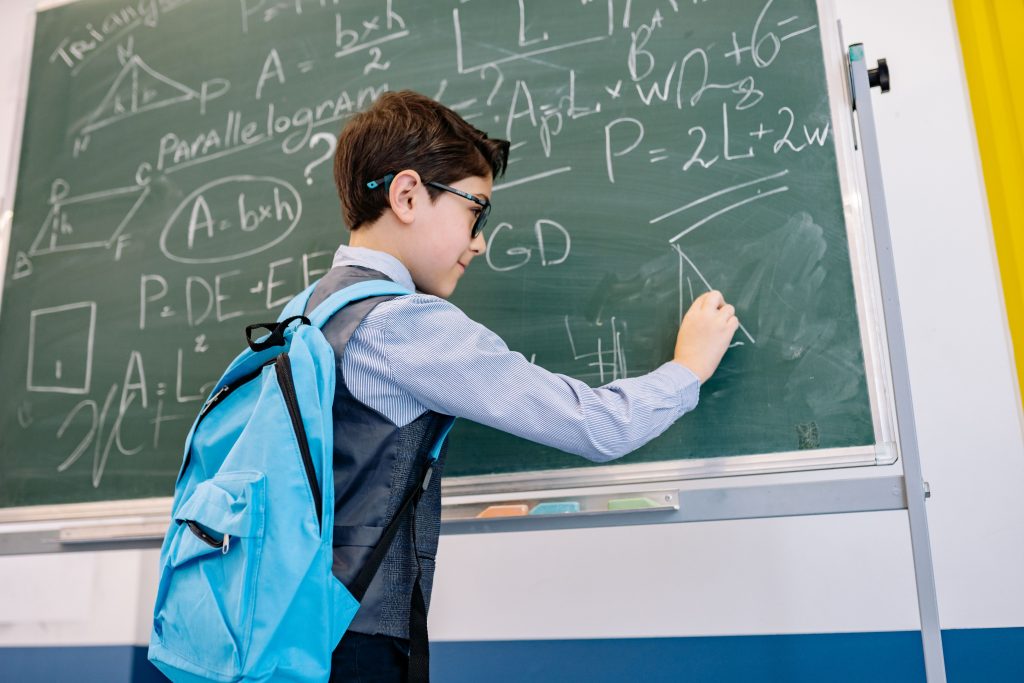

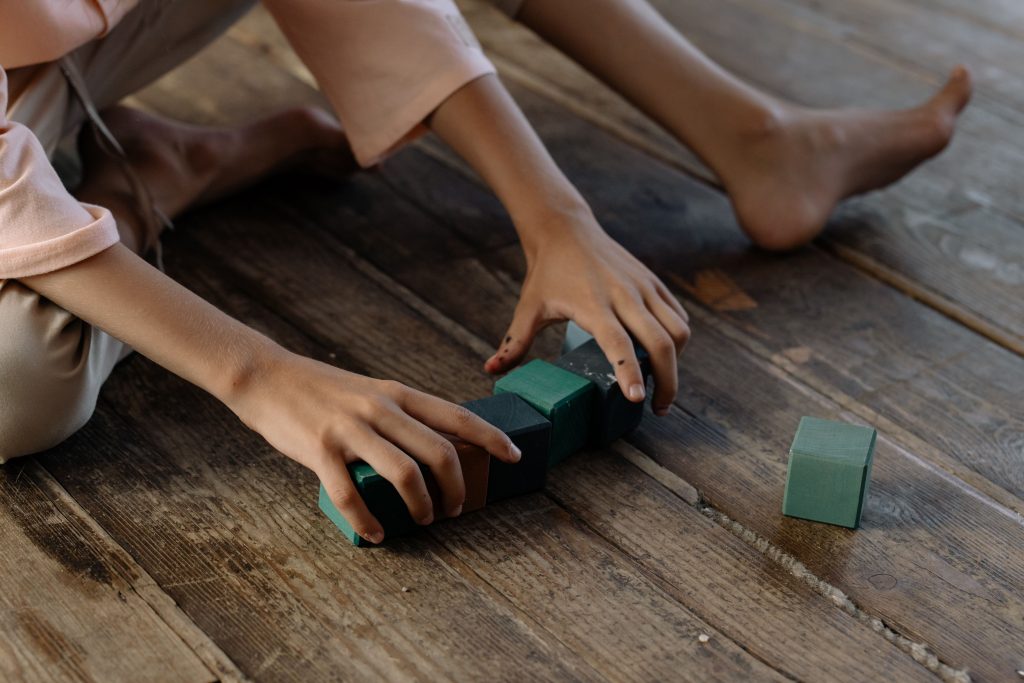
Spatial reasoning questions in the 11 Plus can initially feel very different from Maths or English. There may be few words to interpret and no calculation to perform. Instead, a child must look at shapes, understand their spatial relationships and imagine what happens when those shapes move, rotate, fold or combine.
These skills may appear within non-verbal or spatial reasoning sections, depending on the test used by a particular school or area. The exact 11 Plus format varies because individual schools and local admissions authorities determine which subjects and question types they assess.
GL Assessment, for example, notes that selection tests may include non-verbal reasoning, which assesses problem-solving using pictures and shapes.
Success therefore depends on more than simply having a good “eye for shapes”. Strong candidates develop repeatable methods for different spatial reasoning questions. Instead of trying to visualise an entire complicated diagram at once, they learn to identify fixed features, track individual movements and eliminate impossible answers.

What Is Spatial Reasoning in the 11 Plus?
Spatial reasoning is the ability to understand where objects are positioned and mentally manipulate them. A question might require a child to imagine a shape being turned, determine how a flat net folds into a cube, identify a smaller shape hidden inside a complicated diagram, or work out how several pieces combine.
It overlaps with non-verbal reasoning but is not necessarily identical to it. Non-verbal reasoning can include sequences, analogies, matrices, codes and identifying similarities or differences between figures. Spatial questions focus more specifically on manipulating, viewing and understanding objects in two or three dimensions.
The distinction matters when preparing for the 11 Plus because spatial reasoning doesn’t appear in exactly the same way in every examination. Parents should check the current format for their child’s target grammar school, consortium or admissions area before deciding how much preparation time to devote to it.
When spatial reasoning is assessed, common tasks can include rotations, cube nets, combining shapes, plans or views of 3D objects, paper folding, hidden shapes and counting blocks.
Learn to Break Complicated Shapes Into Small Features
One of the biggest mistakes children make with spatial reasoning is trying to remember an entire shape at once. Complicated figures contain too much information, particularly when several answer options look almost identical.
A more reliable technique is to identify two or three distinctive features.
Imagine an irregular shape containing a long vertical edge, a short diagonal line, and a black dot near one corner. If the question asks which option shows the same shape after rotation, the child doesn’t need to mentally rotate every line simultaneously.
They can track the distinctive corner first. Next, they can check where the black dot sits relative to that corner. Finally, they can confirm the direction of the diagonal line. This converts a difficult visualisation task into several smaller comparisons.
A useful habit is to ask: “What would be hardest for the question writer to disguise?” An unusual angle, asymmetric corner, shaded region or distinctive arrangement of lines often provides the quickest route to the answer.
Use Anchor Points to Solve Rotation Questions
Mental rotation questions show a figure in one orientation and ask the child to identify the same figure after it has been turned.
The crucial rule is simple: rotation changes orientation, but it doesn’t change the internal structure of the figure.
Suppose an arrow-like shape contains a black circle on the left side and a white square near its point. If the entire figure rotates 90 degrees clockwise, those symbols move with the shape. Their positions on the page change, but their relationships to the surrounding parts of the figure remain constant.
Instead of imagining the whole object spinning, choose an anchor point. An asymmetric corner, dot, arrowhead, or shaded section works particularly well. Follow that feature through the rotation and then check its relationship with one neighbouring feature.
This is much more dependable than comparing the overall appearance of the figures, particularly when the answer choices contain both rotations and reflections.
Understand the Difference Between Rotation and Reflection
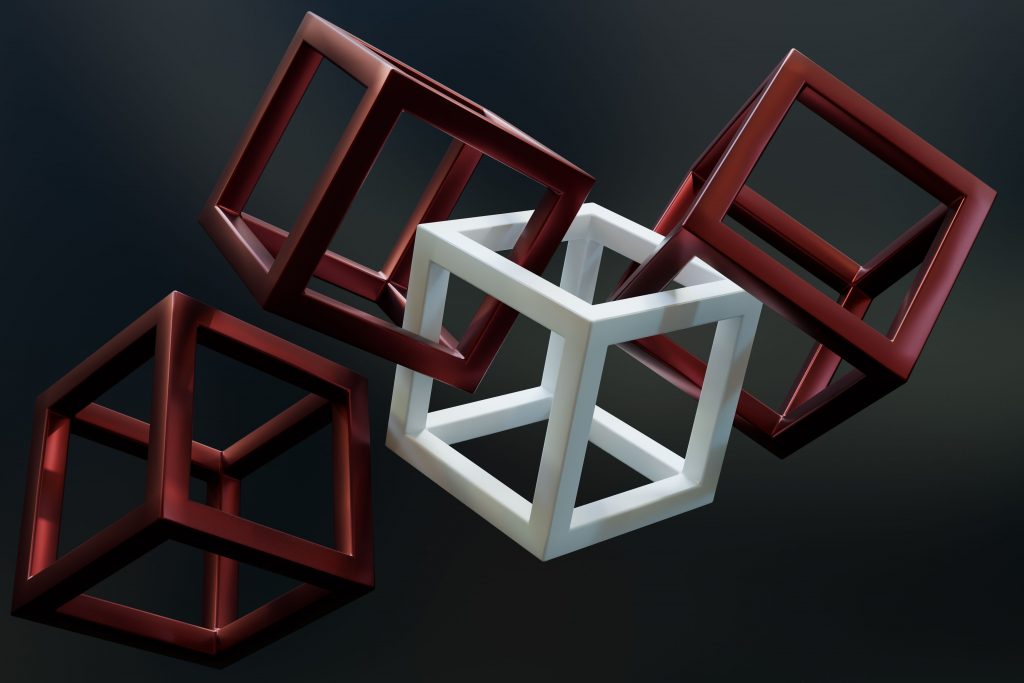
Rotation and reflection are easily confused because both can produce a figure pointing in a different direction. The difference is structural.
Rotation turns an object without reversing it. Reflection produces a mirror image. If two distinctive features appear in clockwise order around the original shape, they retain that order when the shape rotates. A reflection reverses the relationship.
Letters can help children understand the idea. Imagine a capital letter F printed on transparent plastic. Turning the plastic upside down changes the letter’s orientation, but its structure remains intact. Flipping the plastic over makes the F appear backwards.
The same principle applies to abstract 11 Plus figures. When two answers look plausible, avoid asking only, “Could the shape turn this way?” Check whether one option has actually reversed the arrangement of its parts. This distinction can eliminate convincing distractors very quickly.
Track Rotations in Degrees Rather Than Guessing
Children often become faster at rotation questions once they associate common turns with angles.
A quarter-turn is 90 degrees, a half-turn is 180 degrees, and three quarter-turns equal 270 degrees. A complete turn is 360 degrees. The terminology matters less than developing a consistent mental model.
For example, imagine an arrow pointing upwards. After a 90-degree clockwise rotation, it points right. After 180 degrees, it points down. After 270 degrees, it points left.
More difficult questions may rotate a complex figure rather than a simple arrow. The same principle still applies.
A child can identify one easily tracked feature, determine where that feature should move after the required rotation, and reject any answer where it appears in the wrong position.
This technique reduces reliance on intuition. It also becomes particularly useful under timed conditions, when repeatedly turning an entire complicated image mentally can consume valuable seconds.
Solve Cube Nets by Finding Opposite and Adjacent Faces
Cube nets are among the most recognisable 3D spatial reasoning problems. A net consists of six connected squares that can potentially fold into the six faces of a cube.
There are exactly 11 distinct cube nets when rotations and reflections of the same arrangement are treated as equivalent. However, memorising all 11 is not necessarily the best starting strategy for an 11 Plus pupil. Understanding relationships between faces is more transferable.
Start with one square as the base. Imagine the squares immediately connected to it folding upwards. Then determine which remaining square would close the cube.
Pay particular attention to opposite faces. Opposite faces cannot touch along an edge once the cube has been constructed. Conversely, faces that share an edge in the finished cube must meet correctly when folded.
Symbols make this easier. If one face contains a triangle and another contains a dot, track where those two faces end up rather than trying to picture a completely blank cube rotating in space.
Keep One Cube Face Fixed When Mentally Rotating 3D Shapes
Cube questions become considerably harder when children try to rotate all six faces simultaneously. A better approach is to keep one face fixed.
Suppose a visible corner of a cube shows a star on top, a triangle at the front, and a circle on the right. These three faces meet at the same corner. If the cube rotates, their positions may change, but the same three faces must continue meeting around that corner.
That relationship becomes a powerful test.
An answer showing the star, triangle, and circle in an impossible arrangement can be rejected without mentally completing the entire rotation.
This illustrates a broader spatial reasoning principle: relationships are often more useful than positions. “The triangle is below the star” may cease to be true after rotation, but “the triangle shares an edge with the star” remains true.
Children who learn to distinguish temporary positions from permanent relationships tend to make fewer mistakes on 3D questions.
Work Backwards When a Cube Question Feels Too Difficult
Some cube questions are easier to solve from the answer choices than from the original net. Rather than fully folding the net and then searching for a match, inspect each proposed cube and ask whether it violates a known relationship.
Suppose you have already established that the triangle and circle are on opposite faces. Any option showing them touching can immediately be eliminated.
Next, perhaps the star must be adjacent to both the triangle and square. An option violating either relationship disappears as well. This is constraint-based reasoning. Instead of proving one answer correct from the beginning, the child proves several answers impossible.
The method is especially effective in multiple-choice 11 Plus questions because distractors are often designed around predictable errors. One might incorrectly place opposite faces together, while another might reverse the orientation of two neighbouring symbols.
Elimination turns those traps into useful information.
Use Edges Rather Than Area for Hidden Shape Questions
Hidden shape questions require the child to locate a target figure within a more complicated diagram. Extra lines make the target difficult to recognise.
Trying to compare the whole target with every part of the larger image is slow. Instead, identify the target’s rarest feature. It might contain a sharp angle, an unusually long diagonal, two parallel lines or a distinctive intersection.
Find that feature in the larger diagram first. Once a possible match has been located, trace the target one edge at a time. Ignore lines that don’t belong to it. The surrounding clutter is deliberately included to distract the eye, so the ability to disregard irrelevant information is part of the challenge.
Orientation also matters. If the instructions require the target to remain the same way round, a reflected version isn’t necessarily valid even if all the same lengths and angles appear. The goal is systematic tracing rather than visual guessing.
Treat Paper Folding as a Sequence of Reflections
Paper-folding questions usually show a piece of paper being folded one or more times. A hole may then be punched, or a section removed before the child must determine the appearance of the unfolded sheet.
The most reliable approach is to reverse the process one fold at a time.
Every time a fold is opened, the existing pattern is reflected across the fold line. A punch made through two layers therefore produces corresponding positions when the paper opens. With multiple folds, the number and arrangement of resulting marks depend on the sequence of folds and whether any marks lie directly on a fold line.
The key is not to jump immediately from the final folded shape to the completely opened sheet. Reverse the last fold first. Place the reflected mark. Then reverse the previous fold and reflect the resulting pattern again.
Thinking of unfolding as repeated reflection gives the child a rule they can apply even when the diagrams become unfamiliar.
Paper-folding questions are among the spatial reasoning formats found in GL-style preparation materials.
Use Symmetry to Predict Where Marks Will Appear
Symmetry provides an additional shortcut for folding and reflection problems.
If a piece of paper is folded exactly in half and punched away from the fold, opening it produces two marks positioned symmetrically around the fold line. Another fold can create another level of symmetry.
Rather than trying to remember where every layer of paper was located, identify the relevant axis. Ask two questions: how far is the mark from the fold line, and on which side should its reflected partner appear?
Distance from the fold is preserved during reflection. A hole 1 cm from the fold doesn’t suddenly appear 3 cm away after the paper opens.
This concept is useful beyond paper folding. The same thinking can help with mirror images, reflected patterns, and some non-verbal reasoning transformations.
Learning the underlying principle of symmetry is therefore more valuable than memorising the appearance of particular practice questions.
Count Cubes by Columns, Including the Ones You Can’t See
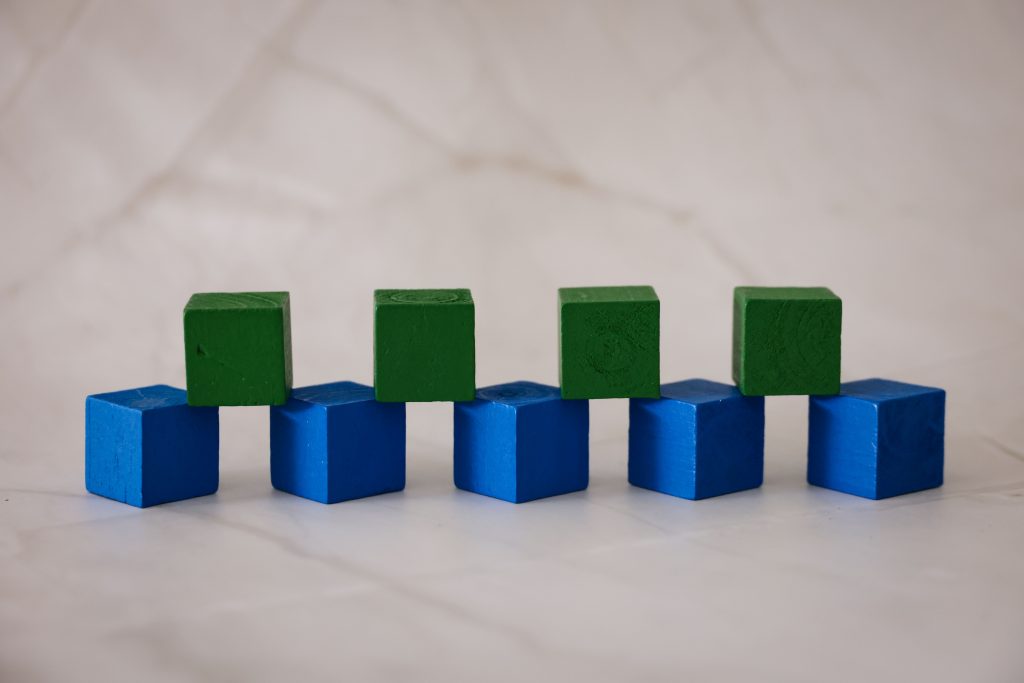
Block-counting questions test whether a child can infer hidden parts of a 3D structure.
The visible cubes aren’t always the complete structure. If a cube appears above ground level, something normally has to support it. That supporting cube may be hidden behind other blocks.
A reliable method is to divide the structure into vertical columns. Instead of counting visible cube faces, determine the height of each column. A column three cubes high contributes three cubes even if only the top and front portions are visible. Then add the column totals.
For example, if five positions contain columns of heights 1, 3, 2, 1 and 4, the structure contains 11 cubes.
This technique prevents a common error: counting only what can be seen. It also makes larger structures easier because the child is solving several small height problems rather than interpreting one complicated 3D drawing.
Read 3D Views Row by Row
Some spatial reasoning questions ask what a structure would look like from above, from the side, or from another viewpoint. The difficulty comes from mentally changing perspective.
For a top-down view, imagine looking directly down at the structure. Height may disappear from the representation, while the positions occupied by columns remain visible. Two columns of different heights could therefore occupy identical-looking squares on a plan.
A systematic approach is to work through the structure row by row. Start at one edge and record which positions contain blocks. Then move to the next row. Pay attention to gaps because an empty position can distinguish two otherwise similar answer choices.
For side views, perform a similar process by mentally compressing the structure along the viewing direction.
Children often find these questions easier after physically building simple structures with cubes and drawing what they look like from above, front, and side.
Find Distinctive Pieces First in Shape-Combination Questions
Shape-combination problems show several pieces and ask which group can produce a target shape, or which piece completes an existing figure.
Don’t begin by trying every combination. Look for the most restrictive feature of the target. If the target contains a narrow projection, deep corner, or unusual angle, only certain pieces can create it. Start there.
Once the distinctive section has been matched, consider what space remains. The remaining piece must fit that space without overlapping existing pieces or leaving an unwanted gap.
Children should also remember that pieces may rotate. Unless the question specifically permits reflection, however, turning a piece over shouldn’t automatically be assumed. This distinction is important because a reflected piece can look extremely similar to a rotated one.
Working from the most distinctive feature reduces the number of possible combinations and prevents random trial and error.
Use Elimination Before Attempting Full Mental Visualisation
Multiple-choice spatial reasoning questions don’t always require a child to construct the correct answer mentally from beginning to end. Sometimes it’s faster to identify what can’t be correct.
Suppose five answer options show different rotations of a complex object. One contains the wrong number of shaded sections. Another reverses two features and must therefore be a reflection. A third places two parts together that were not adjacent in the original.
Three choices can disappear before the child attempts any demanding mental rotation. This is particularly helpful when time is limited.
Elimination shouldn’t become careless guessing. Every rejected option needs a reason. Children should learn to verbalise that reason during practice: “This can’t be correct because the dot should remain next to the triangle.”
Being able to explain the rejection shows that the child is applying a rule rather than choosing the answer that merely looks right.
Draw Temporary Marks Mentally Rather Than Physically
Children often want to draw arrows, numbers or lines all over a spatial reasoning diagram. During practice, annotation can be useful, but pupils also need techniques that work within the rules and format of their actual examination.
A helpful alternative is mental labelling. Call a distinctive corner A. Call another B. Then track A and B as the figure moves.
For a cube, a child might think of three symbols as “star-top, dot-front, cross-right”. After imagining a rotation, they can deliberately update those positions.
This reduces cognitive load because labels are easier to hold in working memory than complicated visual details.
Physical practice can strengthen the same skill. Rotating building blocks, folding paper nets, completing tangrams and assembling construction toys help children connect 2D diagrams with actual objects. Over time, they can internalise these movements and rely less on physical manipulation.
Separate Pattern Reasoning From Spatial Manipulation
Not every picture-based 11 Plus question is primarily spatial.
A sequence of shapes may require the child to identify a logical rule rather than visualise an object moving through space. The figure might rotate 90 degrees on every step while simultaneously changing shading, increasing the number of dots or alternating between two shapes.
Trying to solve every visual problem as a rotation question can therefore create mistakes.
First identify what’s changing. Check orientation, position, number, size, shading and internal markings separately. More difficult sequences often contain two rules operating simultaneously.
For example, the outer shape might rotate clockwise while a dot moves anticlockwise. Looking only at the overall figure makes the sequence confusing. Tracking the outer shape and dot independently reveals two simple patterns.
This decomposition technique also helps with matrices and analogies, both common forms of non-verbal reasoning.
Develop Accuracy Before Trying to Work Faster
Spatial reasoning can be highly time-sensitive, but speed shouldn’t be the first training objective. When a child repeatedly practises an incorrect method quickly, they simply become faster at making the same mistake.
Early practice should therefore be untimed or lightly timed. Ask the child to explain how they reached each answer. If they say, “It just looked right”, encourage them to identify a specific rule or relationship.
Once the method becomes reliable, introduce time limits gradually. A useful progression is to practise one question type in isolation, then mix several familiar types together and finally complete exam-style sections under realistic timing.
Mixed practice matters because the child must learn not only how to solve a cube net or hidden shape but also how to recognise which technique a new question requires. That recognition should eventually become almost automatic.
Keep Moving When One Question Consumes Too Much Time
A difficult spatial question can absorb several minutes because children often feel they’re “nearly there”. That can be costly in a timed assessment.
If a question remains unclear after a sensible attempt, the child should follow the test’s rules for moving on and returning later if possible. The precise strategy should reflect the format and instructions of the actual examination.
The underlying principle is to avoid sacrificing several accessible marks for one unusually difficult problem.
Spatial questions can vary sharply in difficulty. A complicated cube net might require substantial visualisation, while the next question may involve a straightforward rotation that can be solved quickly.
Practice papers are useful partly because they teach this judgement. The child begins to recognise the difference between a problem that needs another ten seconds and one that’s becoming a time trap.
Review Wrong Answers by Identifying the Exact Error
Simply recording a spatial reasoning question as “wrong” provides very little useful information. The child needs to understand why it was wrong.
Perhaps they confused reflection with rotation. Maybe they failed to account for a hidden cube. They might have placed opposite cube faces next to one another or lost track of a symbol during a 270-degree turn. These are different problems and require different corrections.
An error log can therefore classify mistakes by cause rather than just question type. Over several practice sessions, patterns become visible.
If most mistakes involve reflection, additional cube-net practice may not address the real weakness. If accuracy is high when untimed but drops sharply under timed conditions, the issue may instead be speed or decision-making.
This kind of targeted review makes 11 Plus practice considerably more efficient because revision time goes towards the specific reasoning processes that need improvement.
Build Spatial Reasoning Away From Practice Papers
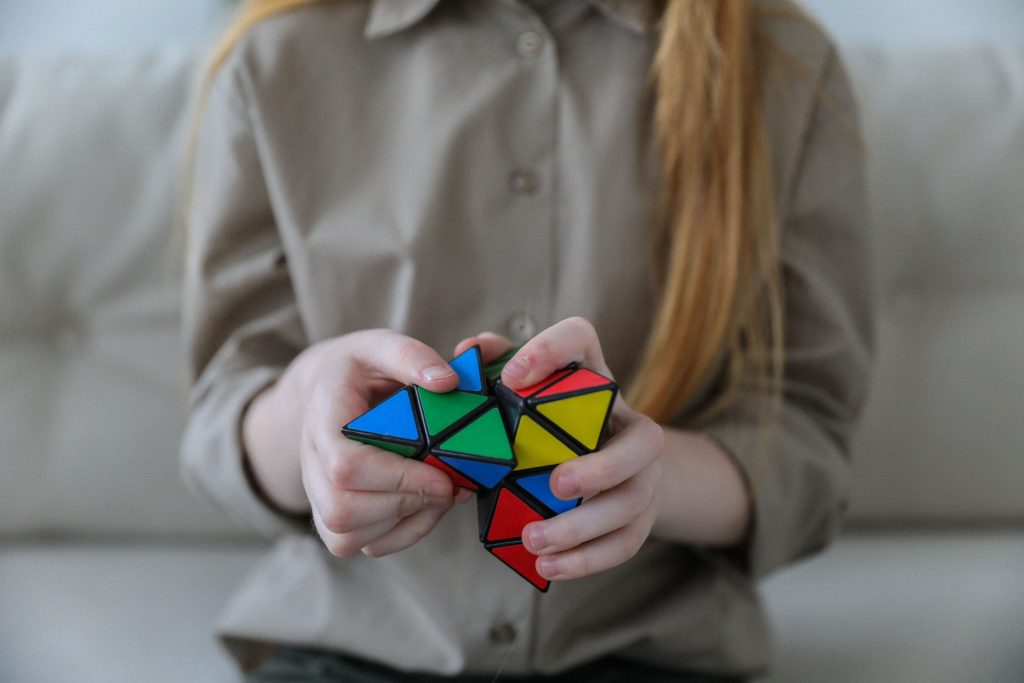
Spatial reasoning is one area of 11 Plus preparation that lends itself particularly well to practical activities.
- Construction toys encourage children to predict how pieces fit together.
- Tangrams develop shape composition.
- Jigsaws strengthen visual matching.
- Origami connects flat patterns with 3D forms.
- Drawing a familiar object from different viewpoints develops perspective.
Cube nets can be especially useful. A child can draw a net on card, mark each face with a different symbol, cut it out, and physically fold it. After doing this several times, ask the child to predict which faces will become opposite before folding the net.
Gradually remove the physical support. This progression from handling an object to imagining it is valuable because spatial reasoning questions require the child to perform mentally what they could otherwise demonstrate with real materials.
Practice becomes less about memorising answers and more about developing an internal model of how objects behave in space.
Match Spatial Reasoning Preparation to the Actual 11 Plus Exam
There’s no single national 11 Plus paper. Schools, consortiums and admissions authorities can use different providers, combinations of subjects and question formats. GL Assessment itself states that the subjects tested and balance of question types can vary according to the relevant authority or school.
Parents should therefore establish the format used by their target schools before buying large quantities of practice material. Check whether spatial reasoning is assessed, how it relates to the non-verbal reasoning component, what types of questions pupils are likely to encounter and whether the test is paper-based or digital.
Preparation should then resemble the real assessment increasingly closely as the test approaches.
Topic exercises are excellent for learning techniques. Mixed questions develop recognition. Full practice papers develop pacing, concentration and decision-making.
Each serves a different purpose, so jumping straight into repeated mock tests can leave underlying weaknesses unresolved.
Turning Spatial Reasoning Techniques Into Reliable Exam Skills
The most effective techniques for solving spatial reasoning questions in the 11 Plus all reduce the amount of information a child must manipulate at once.
- For rotations, track an anchor point instead of spinning the entire image mentally.
- For reflections, check whether the order of features has reversed.
- For cube nets, establish adjacency and opposite faces.
- For hidden shapes, trace distinctive edges.
- For paper folding, reverse one fold at a time.
- For block structures, count columns rather than visible surfaces.
These methods turn spatial reasoning from a collection of mysterious visual puzzles into problems governed by consistent rules.
Regular practice remains important, but the quality of that practice matters more than simply completing large numbers of questions. Children should understand why an answer works, analyse why incorrect answers fail and gradually apply the same reasoning under tighter time limits.
With that foundation, spatial reasoning becomes less dependent on instinct. Children approach unfamiliar 11 Plus questions with a method, which is exactly what they need when the shapes on the real paper look different from anything they have practised before.