

Latymer School 11 Plus Guide: Admissions, Catchment, Exam Format and Preparation
The Latymer School is one of the most competitive grammar schools in North London, so preparing for its 11 Plus exam isn’t only about doing more practice papers. Parents need to understand how the admissions process works, which children are eligible, how the catchment area affects offers, what the test actually includes, and how results are ranked before places are allocated.
For Year 7 entry, children sit assessment tests in Mathematics, Verbal Reasoning, and English. The Maths and Verbal Reasoning sections are GL Assessment multiple-choice papers, while the English paper is set by the school and includes reading and writing.
The school doesn’t use a simple pass mark. Instead, candidates are ranked using age-standardised scores, and only the highest-ranked candidates in the first stage have their English papers marked.
That means Latymer’s preparation needs to be balanced. A child can’t focus only on fast Maths and Verbal Reasoning practice and then treat English as an afterthought. The first ranking matters because it decides whether the English paper is marked, but the final ranking also depends on the English score for those who reach that stage.
This guide explains the full process, including the school overview, catchment area, pass mark, exam format and preparation strategy. It also shows where to use practice questions, preparation guides, and app-based learning to build a realistic study routine.

The Latymer School Overview
The Latymer School is a co-educational selective grammar school in Edmonton, North London. It admits pupils from age 11 to 18 and is regularly seen as one of the most academically competitive state grammar schools in the country.
For many families in North London, it’s a highly attractive option because it combines academic stretch, a strong co-curricular programme and the advantages of selective education without independent school fees.
The school’s Published Admission Number for Year 7 is 192. That number matters because far more children sit the entrance test than there are places available. A child can perform well and still not receive an offer if their ranking isn’t high enough under the admissions criteria. This is one reason parents should avoid thinking of Latymer as a school where “passing” the test automatically means getting in.
Latymer is also different from some grammar schools because the admissions process includes both academic ranking and residence rules. The school operates an Inner Area, which means families must pay close attention to the catchment rules before investing heavily in preparation. A high score is important, but eligibility and correct application steps are just as important.
Before preparing seriously, parents should check three things.
- First, does your child live in the relevant Inner Area or meet one of the specific admissions categories?
- Second, are you able to register for the school’s assessment by the deadline?
- Third, are you prepared for an exam that tests speed, accuracy, reasoning, comprehension, and writing?
If the answer to all three is yes, Latymer can be a realistic goal, but it needs focused preparation.
How Latymer School Admissions Work
Latymer admissions involve more than sitting the test. Parents need to complete the school’s Supplementary Information Form, usually called the SIF, and they must also name The Latymer School on the Common Application Form, or CAF, through their local authority. These two steps are separate, and missing either one can cause serious problems.
The SIF is the school’s own test registration form. It allows your child to sit the compulsory assessment tests. The CAF is the local authority form used for secondary school applications.
Parents sometimes assume that registering for the test is enough, but it isn’t. If The Latymer School isn’t named on the CAF, the local authority can’t process the school as one of your preferences.
The test is usually taken at the beginning of Year 6. Children sit the assessment at The Latymer School, and all papers are taken on the same day.
The school then marks the Maths and Verbal Reasoning papers first. These results create the first ranking. Candidates in the top group then have their English paper marked, and a new ranking is produced after English is added.
Parents receive results before the CAF deadline so they can make an informed decision about whether to include Latymer as a preference.
However, a strong ranking doesn’t guarantee a final offer. Final allocation depends on the number of places, oversubscription criteria, residence rules, and the coordinated admissions process. National Offer Day then confirms whether a place has been offered through the local authority.
Latymer School Catchment Area
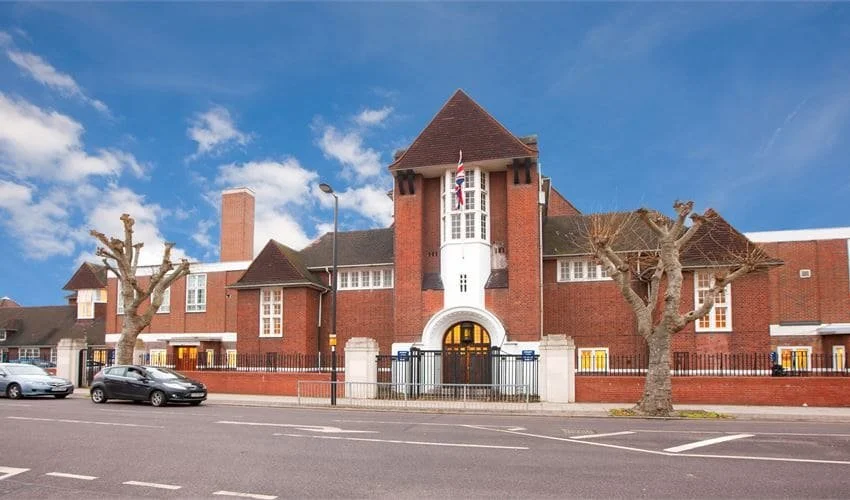
The Latymer School catchment area is called the Inner Area. This is one of the most important parts of the admissions process because Latymer doesn’t simply admit the highest-scoring children from anywhere.
For normal Year 7 entry, the school only admits pupils from its published Inner Area, except where specific admissions rules apply.
The Inner Area includes selected postcodes across North and East London. These include E2, E4, E5, E8, E9, E17, EN1, EN2, EN3, EN4, parts of EN5, parts of EN8, and a wide range of N postcodes including N2, N3, N4, N5, N6, N7, N8, N9, N10, N11, N12, N13, N14, N15, N16, N17, N18, N19, N20, N21 and N22.
Some postcode areas have exclusions or sector-specific rules, so parents should always check the latest admissions document rather than relying on a simplified list.
The school defines the main address as the place where the applicant spends weekday nights in the ordinary course of events. This wording matters because families sometimes ask whether they can use a relative’s address, a temporary address or a shared-care arrangement.
The safest approach is to use the child’s genuine main address and make sure it matches the evidence required by the school and local authority.
Catchment can affect a family’s decision even before preparation begins. If you’re outside the Inner Area, a very high practice score won’t necessarily make Latymer a viable option. If you’re moving into the area, you need to understand the school’s deadline for address evidence.
For families already inside the Inner Area, catchment doesn’t remove the academic challenge, but it does mean the child can be considered under the main admissions route if they reach the required ranking position.
Latymer School Pass Mark
There is no fixed Latymer School pass mark. This is one of the most misunderstood parts of the admissions process. Parents often want a percentage, such as 80%, 85%, or 90%, because it feels easier to plan around a number.
Latymer doesn’t work like that. The school uses age-standardised scores and rank order, which means your child’s position depends on how they perform compared with the rest of the cohort.
The first ranking comes from the Maths and Verbal Reasoning papers. These are marked first, and candidates are placed in order based on their combined age-standardised score.
In normal terms, candidates ranked in the top 700 have their English papers marked. Children below that threshold are generally not considered under academic ability, although specific oversubscription criteria may have different thresholds.
The second ranking is produced after English is marked for the top group. The English raw score is added into the process, and candidates are re-standardised.
This can change positions. A child who performs strongly in GL Maths and Verbal Reasoning but weakly in English may fall in the second ranking, while a child with a strong English paper may move up.
For practice purposes, parents should avoid treating any unofficial target score as a guarantee. A child should aim for consistently high performance across Maths, Verbal Reasoning, comprehension, and writing.
If you’re using practice questions, the goal isn’t just to reach a percentage once. The stronger indicator is whether your child can perform accurately under timed conditions, recover from difficult questions, and maintain quality in written English after a demanding first paper.
Latymer School 11 Plus Exam Format
The Latymer School 11 Plus exam includes Mathematics, Verbal Reasoning, and English. The Maths and Verbal Reasoning test is set by GL Assessment and is multiple choice. It lasts 60 minutes in total, with 30 minutes for Maths and 30 minutes for Verbal Reasoning.
The English paper is set by the school and also lasts 60 minutes, split between reading and writing.
The Maths paper is designed to test Key Stage 2 skills, but the challenge comes from pace, accuracy and problem-solving. Children need to be comfortable with numbers, fractions, decimals, percentages, ratios, measures, geometry, data, and multi-step word problems.
Latymer candidates need more than classroom familiarity. They need to recognise question types quickly and avoid losing marks through small errors.
The Verbal Reasoning section tests language logic, vocabulary, pattern recognition, and deduction. GL-style Verbal Reasoning rewards children who can work quickly and methodically. Vocabulary matters, but so does flexibility. A child who relies only on memorised word lists may struggle when the question demands reasoning rather than recall.
The English paper is especially important because it separates Latymer from schools that rely only on multiple-choice English. Children read an extract and answer questions, then complete a creative writing task.
This means preparation must include comprehension, inference, vocabulary, evidence selection, planning, sentence control, description, structure, and accuracy. Strong writing doesn’t mean using the longest words. It means writing clearly, with control, imagination, and purpose.
Latymer School Maths and Verbal Reasoning Test
The Maths and Verbal Reasoning test carries huge importance because it decides which candidates move forward to the English marking. Since only the top-ranking candidates from this first part have their English papers marked, children need to be secure, fast, and calm in these two areas.
For Maths, preparation should begin with Key Stage 2 foundations. If a child has gaps in fractions, decimals, percentages, times tables, area, perimeter, or word problems, timed practice will expose those gaps quickly.
The best preparation doesn’t start with difficult papers. It starts by making core skills automatic, then gradually adding mixed questions and time pressure.
GL Assessment Maths questions often require children to choose the correct answer from several options. Multiple choice may sound easier, but it can be deceptive.
Wrong options are often designed around common mistakes. If a child rushes, misreads a unit, skips a step, or estimates too casually, the incorrect answer may still be waiting in the options.
Verbal Reasoning needs regular, short practice. Children improve when they meet a wide range of question types and learn how to approach unfamiliar patterns.
The strongest candidates don’t panic when a question looks new. They slow down enough to understand the rule, then work efficiently. Vocabulary development should also happen through reading, discussion, and word exploration, not just isolated lists.
Latymer School English Paper
The Latymer English paper deserves serious attention because it can change the final ranking. Some parents focus heavily on GL Maths and Verbal Reasoning because those papers are marked first, then leave English until late.
That’s risky. If your child reaches the top group, English becomes part of the final score, and weak writing or shallow comprehension can cost places.
The reading section usually requires children to engage with an extract and answer questions. To do well, they need to understand explicit meaning, infer character feelings, interpret vocabulary in context, identify evidence, and explain how writers create effects.
This is different from simply reading quickly. A strong reader can slow down at key moments, notice tone, and support answers with precise detail.
The writing section tests creative control. Children need to produce a piece of writing within a limited time, so planning matters. They should know how to create atmosphere, develop a moment, vary sentences, use description naturally, and avoid losing control of punctuation. The best writing feels purposeful. It doesn’t read like a memorised story forced into a prompt.
Preparation should include regular writing practice, but not endless full stories. Short, focused exercises can be more useful: writing an opening paragraph, describing a setting, improving dialogue, rewriting a dull sentence, or planning a story arc in five minutes.
Over time, these skills help children write with confidence under exam pressure.
How to Prepare for the Latymer School 11 Plus

Good Latymer preparation should be structured, but it shouldn’t feel like panic from Year 4 onwards. Most children need a steady plan that builds core skills first, introduces exam technique gradually, then moves into timed practice closer to the test.
The first stage is foundation building. In Maths, this means making sure Key Stage 2 content is secure. In English, it means reading widely, discussing texts, expanding vocabulary, and writing regularly. In Verbal Reasoning, it means learning question types and developing flexible thinking.
This stage is slower, but it saves time later because children aren’t trying to fix basic gaps during mock season.
The second stage is targeted practice. This is where 11 Plus practice questions become useful. Parents can identify weaker areas and use focused exercises to improve them.
If a child consistently loses marks on fractions, there’s no point in doing full mixed papers every day. They need direct work on fractions, then mixed practice once the skill improves.
The third stage is timed exam preparation. This should include GL-style multiple-choice practice for Maths and Verbal Reasoning, plus written English tasks under realistic time limits.
Mock tests can help children build stamina, but they should be used carefully. A mock is only valuable if you review it properly afterwards. The question isn’t just “What score did you get?” It’s “Why were marks lost, and what needs to change next?”
Latymer School Practice Questions and Preparation Resources
Latymer School practice questions should cover the full exam, not just the easiest-to-mark parts. Maths and Verbal Reasoning are important because they determine whether the English paper is marked, but English preparation is what helps a strong candidate stay competitive in the final ranking.
For Maths, practice questions should include arithmetic fluency, problem-solving, geometry, measures, fractions, decimals, percentages, ratio and data handling.
The questions should gradually become more mixed because the real test won’t tell your child which topic is being tested. Mixed practice helps children decide which method to use without being prompted.
For Verbal Reasoning, preparation should include vocabulary, code questions, word relationships, sequences, logic, and pattern-based questions. Short, regular practice is usually better than rare long sessions. Children need enough repetition to recognise question types, but not so much that they only learn by memory.
For English, practice should include comprehension questions and writing tasks. Children should learn how to answer in full, use evidence, explain inference, and manage time. Creative writing practice should focus on quality, not length. A controlled, well-structured piece is usually stronger than a long piece full of errors.
This is where internal resources can support the journey. Parents can use 11 Plus practice questions to target weak areas, preparation guides to plan the year, and the app to create consistent weekly practice without turning every evening into a full exam session.
Common Mistakes Parents Make When Preparing for Latymer
Preparing Only for GL-style Questions
It’s easy to do because multiple-choice practice feels measurable. Parents can see a score immediately, and children often prefer questions where there’s one clear answer.
But Latymer includes a school-set English paper, and written English needs time to develop. Children who don’t practise writing under time pressure may struggle even if they’re strong readers.
Ignoring the Admissions Process Until Too Late
Parents need to check the SIF deadline, CAF deadline, catchment area, and address evidence rules. A child can prepare brilliantly, but if the school isn’t named on the CAF or the family doesn’t meet the residence requirements, the application can fall apart.
Start Full Mock Exams Too Early
Mocks are useful, but they can become discouraging if a child takes them before learning the content. Early preparation should feel more like skill-building. Timed papers become more useful once the child has enough knowledge to benefit from the feedback.
Focus Too Much on One Score
A single practice-paper result doesn’t define your child’s chances. What matters is the trend. Is accuracy improving? Are careless mistakes reducing? Is timing becoming more controlled? Is writing clearer than it was two months ago? Those patterns tell you far more than one Saturday morning test score.
Frequently Asked Questions
Is The Latymer School hard to get into?
Yes, The Latymer School is very competitive. It has 192 Year 7 places and attracts many academically strong applicants from across its eligible area.
The challenge isn’t only the difficulty of the papers. It’s the ranking system. Your child needs to perform strongly compared with other candidates, not just reach a simple pass mark.
This is why balanced preparation matters across Maths, Verbal Reasoning and English.
What exam board does Latymer use?
Latymer uses GL Assessment for the multiple-choice Maths and Verbal Reasoning test. The English paper is set by the school.
This combination means children need both GL-style exam technique and strong written English. A preparation plan that only uses GL-style multiple-choice practice won’t fully prepare a child for the school-set English paper.
What does top 700 mean in Latymer admissions?
The top 700 refers to the highest-ranked candidates after the Maths and Verbal Reasoning papers are marked and age-standardised. In normal terms, these candidates have their English papers marked.
The English score is then added into the process, and a new ranking is produced. Because of tied ranks and oversubscription criteria, parents should read the latest admissions policy carefully rather than relying only on the phrase “top 700.”
When should preparation start?
Many families begin gentle preparation in Year 4 or early Year 5, especially for reading, vocabulary, and Maths foundations.
More focused 11 Plus preparation usually happens during Year 5, with timed practice increasing closer to the exam.
The right timeline depends on the child. A strong reader with secure Maths may need less time than a child with gaps in core skills. The aim is steady progress, not last-minute pressure.

